Editor's Review:
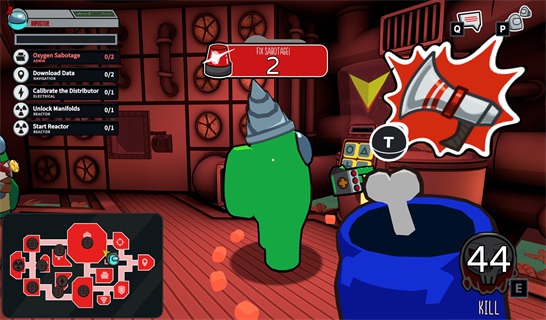
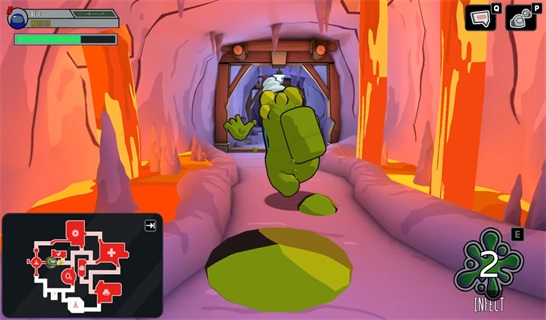
Among Us 3D is a first-person 3D multiplayer social deduction party game. It involves Crewmate tasks, sabotage, emergency meetings, disguise, voting, and the struggle to survive. You can regard it as a party game of teamwork and betrayal. And the game brings familiar mechanics such as tasks, sabotage, meetings, and vents into a more immersive 3D space. Once you truly enter this world, you realize that the biggest difference between this game and the traditional top-down version of Among Us is not simply that the visuals. The real difference is that information feels heavier. In the old view, it often felt as if you were watching a moving chessboard. Here, you are placed directly inside that chessboard. Corridors feel narrower, vision feels shorter, footsteps, distance, and whatever waits around the next corner constantly remind you that you are never seeing the whole truth. What you hear may not be reliable either. The first-person perspective adds pressure to every brief encounter. You do not know whether someone is simply passing by, checking your route, or deciding whether you will become part of their next performance. The most interesting thing about this game is the way it turns crisis into opportunity. If you only define crisis as a body being found, a sabotage countdown, or an emergency meeting being called, then you are only touching the surface.
The real crisis is that everyone lacks complete information, yet everyone is desperate to make a judgment. When a body appears, the situation looks chaotic, but that chaos is also the best moment to take control. You can use your route to build credibility, ask questions to disrupt the rhythm of others, use existing suspicion to shift pressure away from yourself, or turn one small detail into evidence strong enough to change the direction of a vote. By playing this game, you learn how to turn a crisis into an opportunity, because crisis is never just an ending here. It is a chance to redistribute the power owned by each player. If you are a Crewmate, your resources are not limited to the task bar, the map, or security tools. The reactions of the players around you are resources too. You should observe who speaks too quickly, who stays silent for too long, who keeps repeating safe information, who gives vague answers when the question is direct. All of these things matter. If you are an Impostor, the resource system becomes even more complex. Darkness after a lights sabotage, group movement caused by an oxygen countdown, existing distrust between two players, and even the natural bias between friends can all be used. Slowly, you begin to feel that conquering fear is not about suddenly becoming brave. It happens because you know more. When you know where you were, who lacks an alibi, which corridor had no witnesses, and who is easiest to influence during a meeting, fear becomes smaller. Fear comes from the unknown. Every piece of information you collect reduces that unknown.
After enough rounds, you may even start to see other players as pieces on a board. This is not because you look down on them. It is because you finally understand that every player has a position, a personality, a target of suspicion, and a speaking habit that can affect the entire round. Everything after that becomes performance. Other players do not see the complete version of you. They only see the version you choose to show them. There is a famous line from The Art of War that is often translated as "The supreme art of war is to subdue the enemy without fighting." Its core meaning fits Among Us 3D naturally, because the strongest players in this game are often not the ones who argue the loudest or defeat others through direct accusation. They are the players who change the situation before open conflict fully begins. If you are a Crewmate, the cleanest victory is not always a lucky vote at the last second. It is using routes, testimony, and behavioral details across several rounds until the Impostor gradually loses space to move. If you are an Impostor, the highest level of play is not always taking risky kills. It is making other players suspect each other, letting the meeting move toward the outcome you want even when you have barely touched the discussion yourself. A mature player understands that the most effective form of control is not forcing everyone to obey you. It is making them believe they are judging freely while they are slowly walking in the direction you prepared.
This also explains why the more clearly you understand your role, route, and risk in each round, the less likely you are to panic. The more you understand the habits, fears, and decision-making patterns of other players, the easier it becomes to control a meeting. Many players lose not because their mechanics are bad, but because they do not understand how they look in the eyes of others. You may think your explanation sounds clear, while others hear panic. You may think silence keeps you safe, while others read it as avoidance. You may think you are simply observing, while someone else has already turned your pause into suspicion. This game forces you to see two layers of reality at the same time. What you actually did, and what others believe you did. Once you enter that state, self-doubt begins to fade. That feeling is wonderful. You no longer keep asking yourself during meetings whether what you said sounded strange. You no longer fall apart just because someone questions you. You start organizing information with more confidence. First, you state the facts. Then, you explain the reasoning. Finally, you give the room a direction. Even when you are the Impostor, you no longer rush to defend yourself. Instead, you learn to turn suspicion into a better question. When self-doubt fades, your presence becomes stronger. You realize that strength in a social deduction game does not come from having the loudest voice or speaking all the time. It comes from making others feel that you understand what is happening.
The strongest part of the 3D design is that space becomes part of the psychological pressure. With first-person movement and proximity-based social interaction, what you hear is no longer just speech from a channel. It is connected to position, distance, and direction. When someone speaks behind you, you instinctively want to turn around. Once sound and space are tied together, lies become more physical. You are not only looking for logical flaws in text or voice chat. You are reading cracks in tone, pauses, movement, and timing. The game also makes you see your friends differently. In real life, you may spend every day with your friends. You may eat together, talk together, joke together, and feel that you already understand them well. But you may not know what they hide, what they fear, or how they make decisions under pressure. You may not know whether they become conservative or aggressive in a crisis. You may not know whether they explain honestly, turn against someone else, protect themselves first, or simply throw the whole room into disorder when suspicion lands on them. In the world of Among Us 3D, when everyone is trying to survive, these hidden patterns rise to the surface. You see who is cautious, who is willing to take risks, who likes to control the room, who is easily pushed by the majority, and who becomes calmer than usual when pressure is at its highest. This kind of observation does not necessarily damage friendship. In fact, it can help you understand the people around you in a fuller way. The game gives everyone a safe stage where parts of their personality that rarely appear in daily life can become visible. A usually gentle friend may show surprising pressure in a meeting. A friend who always jokes around may become extremely careful at a key moment. Someone who seems to lack strong opinions may catch the smallest inconsistency and turn the round around. You begin to realize that your friends are not fixed versions of the daily impressions you have of them. Overall, as a multiplayer social deduction game, the truest victory of Among Us 3D is not simply voting someone out. It is discovering after a chaotic round that fear can be controlled by information, self-doubt can be pushed down by action, and when you choose to act like the strongest version of yourself, you really do begin to move closer to that version!