Editor's Review:
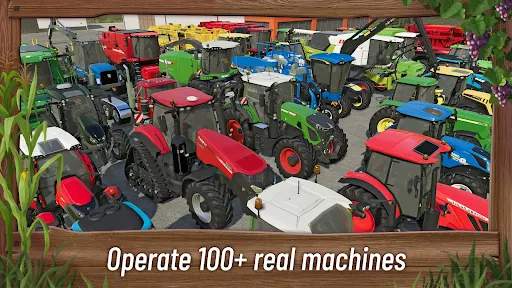
Farming Simulator 23 is an agricultural simulation game. It mainly involves farm management, machinery driving, crop planting, animal husbandry, and production chain management. What it gives you is not a simplified farm where you only drive a tractor around the field a few times, but a relatively complete modern agricultural ecosystem. The land needs to be prepared, crops need to be planned, equipment needs to be scheduled, animals need to be cared for, products need to be transported, and production chains need to be built step by step. This game includes more than one hundred real machines and tools, along with grapes, olives, forestry, animal husbandry, production chains, plowing, weeding, AI helpers, and automatic loading of wood and pallets. These systems make it closer to a truly operating modern farm than an ordinary farm management game. What you do in the game seems to be plowing, sowing, harvesting, and selling goods, but after playing for a long time, you will find that it is also training your patience, planning ability, and sense of order. You cannot manage the farm well through a moment of impulse, and it is difficult to complete long-term expansion through a short burst of effort. You have to learn to wait, allocate resources, understand the workflow, and then make every investment bring better returns. The basic process of the game is simple. You need to drive a tractor to prepare the land, choose suitable equipment for sowing, wait for the crops to mature, use a harvester to complete the harvest, and finally turn the result of your labor into money through transportation and sale.
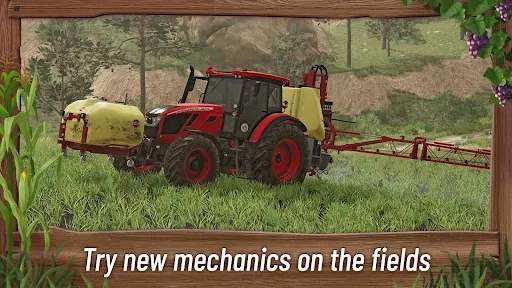
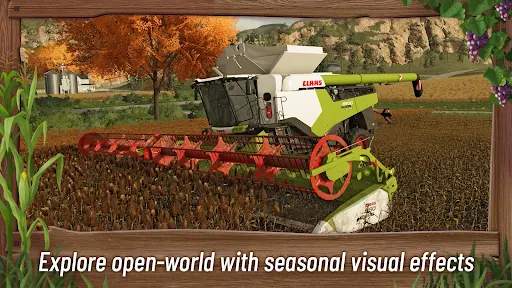
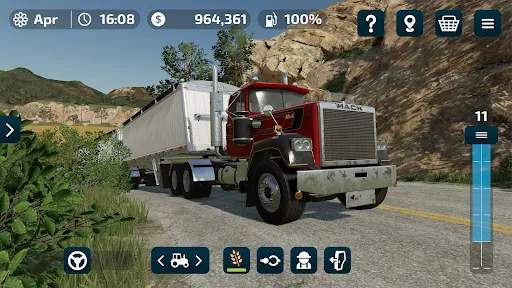
This process may not sound dramatic, but once you actually play it, it can easily create a lasting sense of involvement. Every operation changes the condition of the farm, every harvest affects later development, and every new machine you buy means an improvement in efficiency. You can clearly feel that your farm is gradually moving from a scattered, inefficient, and limited state into a production system that can run steadily. From the perspective of operation, machinery driving is still the most attractive part of this game. Tractors, harvesters, sprayers, trucks, and forestry equipment all have their own uses, and you need to switch machines according to different tasks. When you drive a tractor to pull equipment through the field, you begin to care whether the route is neat, whether the corners have been missed, and whether the turns have wasted time. When you drive a harvester, you pay attention to whether every row of crops has entered the storage tank completely. When you transport goods, you need to consider distance, route, and profit. The pleasure of the game does not come from intense stimulation, but from a real rhythm of labor. You watch a field go from untreated land to a fully sown field. That sense of achievement is stable, clear, and very grounded.
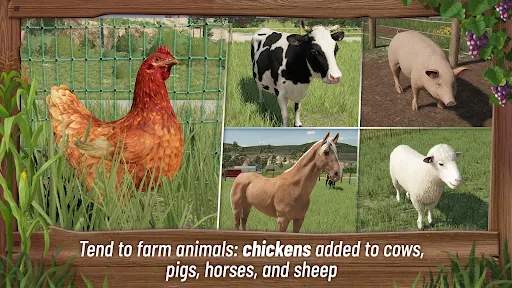
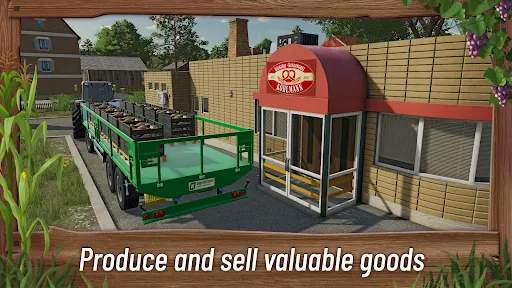
The depth of Farming Simulator 23 comes from the way it expands the single process of growing and selling into a multi-industry operation. In addition to regular crops, you can also plant grapes and olive. You can also do forestry work and care for animals such as cows, sheep, and chickens. The production chain system gives you the chance to process your harvest into products of higher value, then complete the business cycle through transportation. In this way, what you need to think about is no longer only how much money the next harvest can bring, but also what direction the whole farm should take in the future. You can focus on stable crop income, or you can invest resources into animals and processing to gradually increase the overall value of the farm. This is also why it is not easy for you to feel bored. Its long-term goals are not thrown at you all at once, but slowly unfold as the scale of your farm grows. In the early stage, you may only want to keep a few fields running properly. In the middle stage, you may want to replace old machines with more efficient ones and reduce wasted labor. From a different angle, Farming Simulator 23 is actually a game about maximizing profit. Your land is an asset, your machines are assets, your time is an asset, and your crops and animals are also assets. You need to decide whether to expand your land first or upgrade equipment first, whether to sell crops directly for cash or send them into the production chain to increase added value, whether to drive personally to save costs or use AI helpers to leave more time for more important scheduling.
The game does not present management as difficult financial formulas, but it keeps bringing you back to the same question: How can limited resources create higher efficiency? The longer you play, the more clearly you realize that a farm is not better simply because it owns more things. What matters is whether everything can work together. The AI helper and automatic loading features also make the rhythm of this game more suitable for ordinary players. The part that most often makes agricultural simulation games tiring is that repeated labor increases quickly after the scale becomes larger. AI helpers can share part of the field work for you, while automatic loading reduces the tedious feeling of handling wood and pallets. These features do not make all management decisions for you, but they allow you to place more attention on planning, profit, and scheduling. For new players, they lower the pressure of getting started. For veteran players, they keep the management of a large farm from turning into pure patience consumption. Of course, this game still requires you to accept a slow pace. You need to drive machines across fields and transport harvests to specific locations for sale. These processes are realistic, and they do require you to take your time. If you are used to frequent rewards and strong stimulation, you may feel that it moves slowly. If you are willing to plan and persist, it can give you a strong sense of satisfaction. Progress here does not come in sudden bursts, but through accumulation. Today you prepare one more field, tomorrow you buy a more suitable machine, and the day after that you set up a production chain. This is how the farm becomes better little by little.
The visual presentation follows a clear and practical direction. Fields, roads, machines, and crop conditions are all easy to understand, and the uses of vehicles and equipment are also easy to judge. It does not use exaggerated visual effects to take attention away from the simulation. Instead, the visuals serve the experience of operating and managing the farm. When you drive a machine through the field, what truly pulls you in is not how spectacular the scenery is, but the knowledge that you are completing a concrete step. After that step is completed, the farm immediately moves a little closer to a better state. This game also has obvious limitations. The core loop of agricultural simulation will always involve plowing, sowing, fertilizing, weeding, harvesting, transporting, and selling, so repetition will definitely appear after playing for a long time. For players who want deep realism, complex markets, and very high freedom of modification, it may still not go far enough. For players who only want fast entertainment, it may feel too slow. The players who will enjoy it most are those willing to invest time into long-term management and enjoy optimizing processes step by step. Overall, Farming Simulator 23 is an agricultural simulation game with complete content, solid pacing, and clear management goals. It gives you a complete farm ecosystem. You do not only deal with land and crops, but also face animals, forestry, production chains, transportation, and equipment allocation. You switch between different machines and understand the use of each one. You expand the farm through each round of production and feel the improvement of efficiency. You also think about how to maximize profit when calculating costs, arranging routes, and choosing investment directions. As long as you are willing to plan ahead and keep going, you will find that turning a farm into a truly functioning system is the best reward in itself!