Editor's Review:
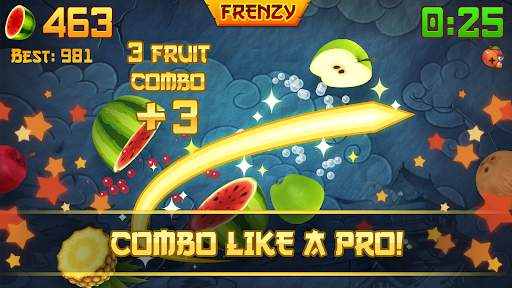
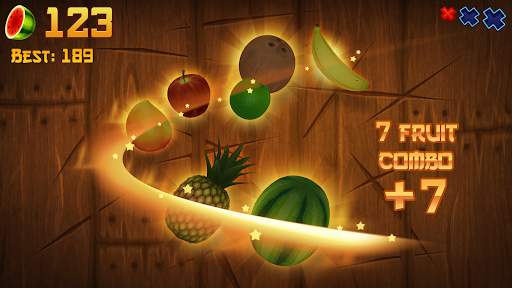
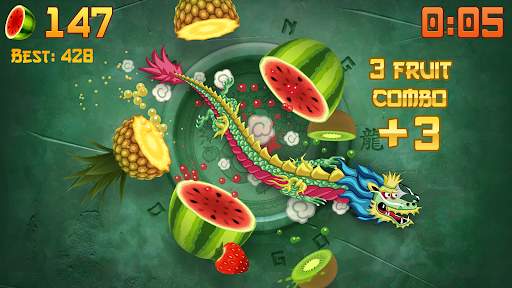
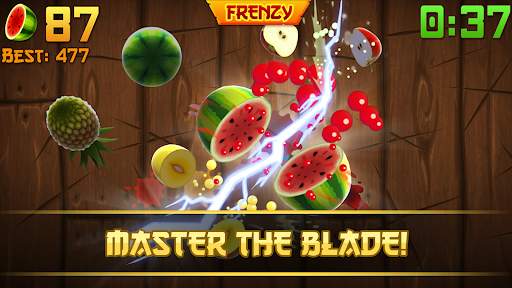
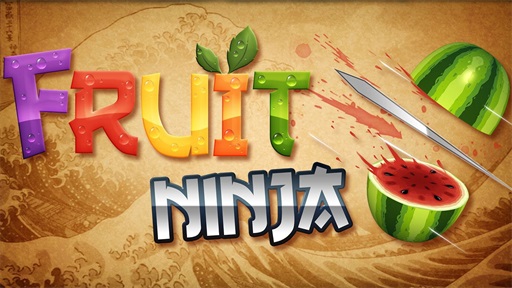
Fruit Ninja is a classic casual action game. What truly makes it impressive is not the simple idea of slicing fruits, but the rhythm, judgment, tactile feedback, concentration, and competitive drive. Almost anyone can understand the gameplay immediately, yet very few people can continue to play beautifully over a long period of time. The British philosopher Bernard Suits once said, "Playing a game is the voluntary attempt to overcome unnecessary obstacles." This sentence fits Fruit Ninja especially well. You are clearly only moving your finger across a screen, but what you are doing is not mechanical repetition. You are constantly accepting the limits imposed by the rules of the game. Bombs cannot be touched, combos should be captured, rhythm must stay steady, vision must stay quick, and your mind cannot fall into disorder. It is precisely because of these unnecessary obstacles that this game can pull you back again and again. Many players talk about Fruit Ninja only by saying that it is satisfying, stress relieving, and classic, but if you have really played it for a long time, you will realize that one of the strongest qualities of this game lies in how well it activates both body and emotion. After you enter this world, you will quickly move into a state that is very happy and very relaxed. This kind of relaxation is not emptiness, but intense focus. The background music is not noisy, the parabolic motion of fruit is smooth, the sound of each slice is crisp and clean, and the splash of juice gives enough vivid visual response. The entire sensory design allows you to leave behind the noise of reality within a few seconds. You are not thinking about complicated goals, and you are not being pushed forward by a story. Instead, in a space with clear rhythm and direct feedback, you hand your attention over to your eyes and your fingers. That feeling is similar to the flowing state a person enters after mastering a small skill. It is not tense, but it is not loose either. It does not feel laborious, yet it is fully absorbing.
Because of this, this game is exceptionally good at creating anticipation. Every time a fresh new wave of fruit rises from the bottom of the screen, you truly feel excited. That excitement is not exaggerated. It is carefully produced by the mechanics of the game. You never fully know what kind of combination the next cluster of fruit will bring. It may be a fan-shaped spread that can be cleared in one elegant swipe, or a crossing pattern that tests your path planning. It may be a dense group that offers easy points, or a tempting arrangement mixed with bombs. So every time a new batch of fruit enters your field of vision, you immediately enter a state of judgment. This moment matters greatly, because it turns the act of seeing itself into part of the pleasure. You are not passively waiting for targets. You are actively welcoming them. That is one of the main reasons why the game does not become hollow as quickly as many other similar games do. It constantly uses the next wave of fruit to generate small but lasting bursts of freshness. Another brilliant side of Fruit Ninja is that it almost turns the idea of reaction potential into something you can directly feel. Many games claim to test reaction, but truly excellent reaction-based games do not only ask you to be faster. They ask you to distribute speed more intelligently. Fruit Ninja does exactly this. When you play, you often slash wildly as soon as you see fruits. You make many movements, but the efficiency is low. After playing for a long time, you begin to understand that a real expert is not simply someone with extreme hand speed, but someone who can complete priority judgment within an extremely short time. So in order to create the best slicing record, you must ask yourself, "Which line of fruit is best for a combo? Which one should be ignored for the moment? Which path saves the most motion? And from which angle a bomb is most likely to cause an accidental hit?" All of this requires you to compress visual recognition, spatial prediction, and physical execution into a reaction chain that is almost simultaneous.
To speak plainly, this game does not merely compare who is faster. It pushes you to refine your sense of speed. You gradually dig into your own reaction potential. You discover that you can actually see so much in such a short time. You discover that you can control the angle and length of your swipes. You discover that even under pressure, you can remain steady. This kind of improvement is reflected in a very pure way through the feel of each round. When your score rises, you know very clearly in your heart that it is not luck. You have genuinely become better. But achieving such excellence is not an easy thing because it requires clarity in your mind. The rules may look simple, but the moment you become a little too anxious, too greedy, or too restless, mistakes appear immediately. This is especially obvious in Classic Mode, where the existence of bombs constantly tempts you into failure. The most dangerous situations are not when there is little fruit on the screen, but when there is a lot of fruit, many opportunities, and a fast tempo. When you become excited, you may be prone to think that you can take everything in one sweep. But if your hand moves too broadly, and the path becomes chaotic, the bomb will be hit at once. In other words, what this game really tests is not whether you can slice fruit, but whether you can stay clear-headed when you most want to slice everything. That is the difference between this game and a pure game of emotional release. It looks easy on the surface, but actually, it demands stable judgment. You must make your vision faster than your emotion, and make your judgment arrive before your movement. This pleasure within clarity is exactly what always attracts your attention and makes you feel good.
Besides, it has a very effective structure of competition among friends. You can compete with your best friends for scores, and this immediately transforms what might have remained a private rhythm-based experience into a challenge filled with social tension. The most interesting part is that the threshold of competition is extremely low. It does not require the long process of learning a complex system like many competitive games do. What you and your friends are comparing is almost the most direct things, including focus, judgment, feel, and stability under pressure. Because the competition is so direct, the emotional response it creates also feels very real. If you beat a friend by one point, you remember it for a long time. If the other person overtakes you by a few slices, you immediately want to start another round out of stubborn refusal to accept defeat. This desire for one more round is not forced by missions or tasks. It is triggered by the clear comparability of the score itself. It allows the game to extend from personal relaxation into a tacit confrontation between two players. You know that your friend also becomes tense when seeing a huge cluster of fruits, and also feels the palms grow damp when approaching a personal record. So this kind of competition is not a cold leaderboard. It is a form of interaction full of human feeling.
From the perspective of design, the greatest success of Fruit Ninja is that it perfectly combines leisure and skills. Fruit Ninja can make you feel excited and let you relax at the same time. The longer you play, the more clearly you feel that your movements are becoming more refined and your judgment becomes more stable. So Fruit Ninja continues to prove how decisive tactile design can be through extremely simple rules. It makes you happy not because it is shallow. It makes you relax not because it lacks challenge. On the contrary, you think you are casually slicing fruit, but in fact, you are organizing attention, training reaction, maintaining clarity, and feeling the pleasure of competition through the rise and fall of scores with every swipe. That is why, even today, Fruit Ninja is still worth serious evaluation. It proves one thing very clearly, that is, a truly good casual game is never just simple and finished, the fact is that it must be able to let you continue to feel excited within simplicity, remain clear-headed within excitement, and dig out your own limits within clarity. Every swipe you make may appear to do nothing more than cutting the fruits apart, but you also cut apart your fatigue, dullness, distraction, and hesitation!