Editor's Review:
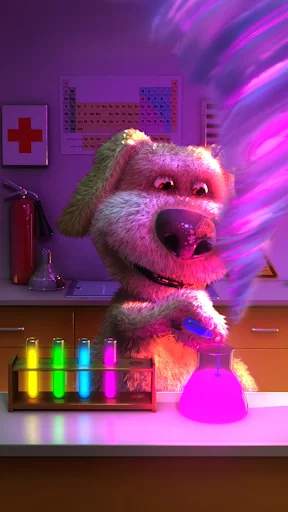
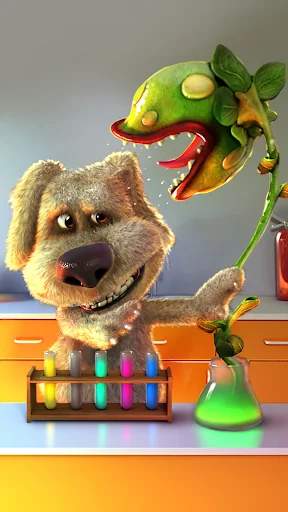
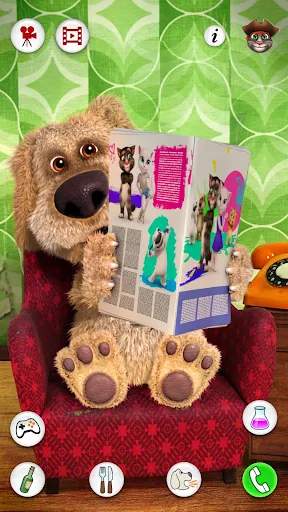
Talking Ben the Dog is a casual electronic pet game focused on voice interaction, touch response, and light care-giving. The strongest part of its design lies in the way it brings together companionship, feedback, and low pressure interaction in a very direct form. For that reason, even though the gameplay is not complicated, it remains unexpectedly engaging, especially for players who want emotional response but do not have the conditions to take on the cost and responsibility of a real pet. The most important part of the experience is the speed and certainty of feedback from Ben, and this sense of immediacy is not just a superficial source of amusement. It is the point at which the game understands players best. In real life, we invest time, energy, and even emotion into many things, yet often have to wait a long time before seeing results, and sometimes we never see them at all. You send a message and the other person may not reply at once. You complete a task seriously and may not receive recognition immediately. You try to care for a relationship well and still may not receive the same intensity of response in return. But in the world of Ben, when you touch him, tease him, or speak to him, he almost always reacts right away. If you poke him, he shows emotion. If you talk to him, he repeats your words in that exaggerated and slightly ridiculous voice. If you call him, he answers. If you take him into the lab, he performs a series of comic reactions with the potions and equipment. This closed loop of action and instant response is the true source of attraction in the design of this game.
Because of that, what deserves the most praise in Talking Ben the Dog is not depth in the traditional sense of gameplay, but the light reconstruction of companionship. Real pet ownership certainly has its irreplaceable warmth and authenticity, but it also requires time, space, money, patience, and a stable living environment. Not everyone has those conditions. Some people are too busy with work. Some people live in places where pets are not allowed. Some people do not have a family environment suitable for introducing an animal that needs long term care. Under those circumstances, Ben offers something more than a substitute for a pet. He provides a more accessible form of companionship. He will not get sick in the middle of the night. He will not shed fur. He does not need walks. He does not disrupt the rhythm of your life. At the same time, when you choose to spend time with him, he can still bring a great deal of ease, joy, and a warm sense of company with almost no burden. In other words, it does not try to trap you with tasks. What it gives you is a gentle relationship placed somewhere between toy, pet, and interactive character. You can treat it as a small game for passing time, but if you truly stay with it for long enough, you realize that it is closer to a digital emotional buffer created for modern life.
What is even more interesting is that although countless players have downloaded the game and interacted with Ben, players still tend to feel that their own Ben is unique. In theory, the model, actions, and voice responses of the character are relatively fixed. It does not offer strong customization, nor does it contain a highly complex training system capable of producing obvious differences. Yet, the actual experience feels completely different. That is because uniqueness does not always come from systems. Very often, it comes from emotional investment itself. What you said to him, at what moment you entered this cute dog's world, how you tapped him repeatedly and listened to him respond when you were in a bad mood, even how familiar you have become with each laugh and each annoyed expression, all of this gradually forms a private relationship. There is a famous line in The Little Prince that explains this feeling very well, "It is the time you have wasted for your rose that makes your rose so important". The meaning of this sentence is that uniqueness does not only come from the object itself, but also from the time and feeling that you have invested in it. Applied to Ben, this idea is almost perfectly accurate. Clearly, every player sees the same Ben, yet you still feel that the one in your phone belongs only to you. That is because you have cared for him, teased him, listened to him repeat your voice, and been accompanied by him in very specific moments. He does not literally become unique, but you give him a unique place in your own emotional world.
Looking a little deeper, the laboratory section is actually one of the most interesting supplements in the whole design. It allows Ben to become more than a passive receiver of touch and voice. In that setting, he can display exaggerated reactions in a more performative scene. In other words, Ben is not only an object that repeats what you say. He is also a character who will perform for you. Many players underestimate the pleasure of simply watching a character react. You do not always need to control him or command him. Sometimes, it is enough just to watch him make ridiculous expressions and movements. The sound performance of the game is also something that deserves separate praise. The repeating function of Ben works not simply because he imitates your words, but because the result carries a very clear sense of character. It is not mechanical repetition. It comes with a lazy, old-fashioned, slightly dismissive, yet sometimes cooperative personality. So you will feel that you are not interacting with an empty program, but with a concrete character named Ben. Once this sense of character is established, even very simple feedback becomes amplified. Many similar games fade quickly because they only have function and no personality. Ben is almost the reverse.
In the end, the real value of the game lies in the natural fusion of electronic pet, voice toy, and lightly interactive character, allowing players to gain stable emotional satisfaction with very little investment. What makes it comforting is that you need almost no preparation in order to build a small but genuine connection with it. If you are busy today and can only play for two minutes, it still works. If you are in the mood and want to stay longer, it still receives you well. It does not bring you trouble, but it gives you response. It does not take over your life, but it can still appear inside your life when you need it. So Talking Ben the Dog is a game that is not complicated in content, yet understands extremely well how companionship is created. Its strength does not lie in grandeur, but in precision. It does not rely on the complex gameplay, but on accurate feedback. It does not try to imprison you, but makes you willing to return. For players who do not have the energy, the time, or the right environment to raise a real pet, Ben really can become a new electronic pet. He does not replace everything in reality, but when reality cannot provide this kind of comfort, he offers a gentle, convenient, and almost consequence free form of joy and companionship. As for why so many players have played with him and still feel that their own Ben is the most special, the answer is already clear. It is because you truly spent time on him, and once time becomes tied to emotion, that originally standardized character slowly turns into something that belongs only to you!