Editor's Review:
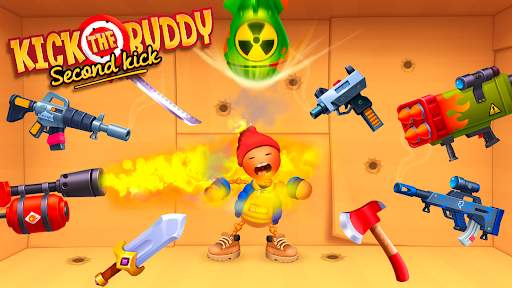
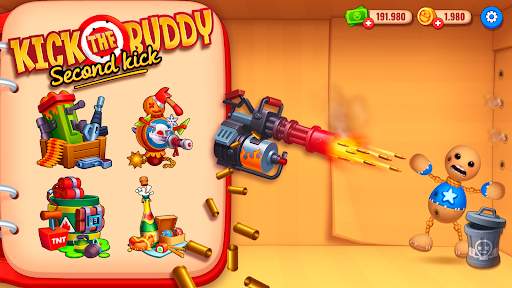
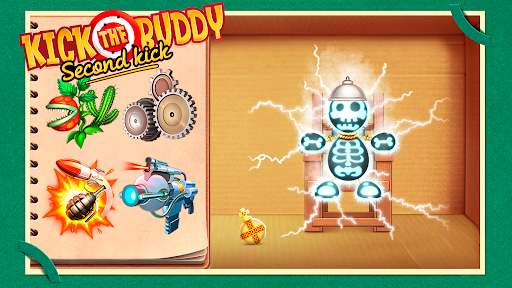
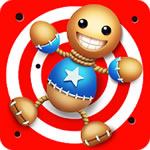
Kick the Buddy: Second Kick is a casual action game mainly about physics-based interaction, stress relief, and destructive experimentation. It is a game about using all kinds of tools to mess with a ragdoll dummy. But what really keeps players coming back is not simple destructive pleasure. It is the extremely immediate, extremely direct feedback: tap once, hit once, blast once, and Buddy instantly responds with exaggerated bouncing, distortion, movement, and sound effects. That high-speed, highly responsive interaction is what allows it to grow from what seems like a simple stress-relief game into something more unusual, that is, a remarkably effective emotional reset button. You can make the target suffer more. What matters is whether the system can turn repetition into pleasure. Kick the Buddy: Second Kick does this surprisingly well. It does not win your heart by offering complex rules. It wins by making tiny variations inside repeated actions feel rewarding. The same punch, the same shot, the same throw, the same explosion can feel different depending on the weapon, the timing, the chain reaction, or even the way Buddy stumbles, rebounds, and rolls into a corner afterward.
In a strange way, it becomes a kind of exercise in rethinking meaning. In daily life, we are always trained to ask whether something is worth doing, whether it leads anywhere, whether it is efficient, whether it produces results. Even leisure often gets turned into another task. Kick the Buddy: Second Kick offers the opposite kind of space. When you interact with Buddy, you gradually stop asking where any of it is "going," because the meaning is no longer at the end. The meaning is in the instant itself, in the tap, the impact, the explosion, the coins flying out, the screen shaking, the noise bursting open for a second and then fading away. The game does not demand that you pursue some grand objective. Instead, it reminds you that pleasure can exist entirely in the present moment, inside a tiny and self-contained loop of action and response. If you push that feeling one step further, you cannot help thinking of Camus and Sisyphus. As Albert Camus famously wrote in The Myth of Sisyphus, "The struggle itself toward the heights is enough to fill a man's heart. One must imagine Sisyphus happy." In Kick the Buddy: Second Kick, you know Buddy will never truly be dead. There is no final ending to the cycle. No matter how many times you hit him, burn him, freeze him, launch him, or blow him apart, the loop continues. Like Sisyphus, you are doing something again and again without reaching a final resolution. Yet once you accept that, frustration strangely disappears. You stop caring about "finishing" Buddy and begin to enjoy the act itself. The process becomes the point. That is not a forced philosophical reading. It is a very practical feeling that emerges after long-term play, that is to say, when this game removes your obsession with the end result, the satisfaction of the present action becomes more vivid.
A huge part of that satisfaction comes from the physical and sensory design. To put it simply, whether Kick the Buddy: Second Kick works or not depends almost entirely on feel. But the "feel" here is not the precise technical feel of a fighting game or a character-action title. It is a more instinctive kind of tactile pleasure. You will love the crispness of a tap, the pull of a drag, the weight of a hit, the chaos of a chain reaction, the ridiculous elasticity of Buddy's body under force. Buddy is basically a response machine built for the player's mood. You give him a little force, and the game amplifies it into a cartoon performance. Every collision, bounce, spark, explosion, and wobble on screen turns internal tension into something visible and audible, something you can spend and get rid of. That is why interacting with Buddy feels so good on a bodily level. It is a kind of satisfaction that asks for almost no learning curve. You do not need to calculate, optimize, or memorize anything. Your hands understand the appeal before your brain explains it. For that reason, you completely understand why so many players love to play a game like this when they are exhausted. In real life, your day may be sliced apart by schedules, messages, obligations, and deadlines. You may already be operating like a machine, trying to hold everything together. But once you enter Kick the Buddy: Second Kick, the rhythm changes immediately. It does not offer achievement anxiety. It offers instant release. You do not need to prove yourself. You do not need to worry about falling behind. You do not need to perform competence under pressure. Buddy is always there, with a kind of absurd patience, waiting for you to unload the irritation you did not have time to process during the day. Ten minutes with it will not solve real problems, but it can genuinely pull your mind back toward a more balanced state.
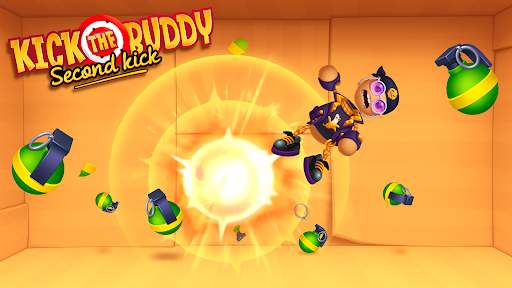
Another thing you will appreciate about this game is that it gives you permission to set reason aside for a moment. Not forever, just for a while. So many games today ask players to maximize efficiency, optimize builds, calculate rewards, or think in terms of perfect systems. The best moments in Kick the Buddy: Second Kick often come when you do the opposite. You stack tools for no good reason. You trigger two or three effects at once just to see what happens. You let the screen get loud and excessive. You stay in a state of pure "what if" instead of trying to play correctly. That is when the game comes alive. It is not a system built around disciplined control. It is a system built around safe, playful indulgence. In that sense, it gives players something unexpectedly valuable. You will have a protected space in which impulse can be harmlessly enjoyed instead of constantly managed. In real life, we spend our days trying to keep everything in order, including our work, our rooms, our messages, our schedules, our emotions, our relationships, our responsibilities. We are always arranging, sorting, balancing, tidying, and containing. But in the world of Kick the Buddy: Second Kick, you are allowed to embrace chaos. And crucially, this chaos is not tragic or dangerous. It is cartoon chaos, sanitized chaos, playful chaos. Objects fly everywhere. Explosions stack on top of each other. Buddy ricochets from one side of the screen to the other. The whole frame becomes absurd. Yet that absurdity is exactly what makes it relaxing. In a world where you are usually the person trying to maintain order, this game briefly frees you from that role. You do not have to hold things together here. You get to watch them come apart in a way that is silly, harmless, and oddly soothing.
In conclusion, what Kick the Buddy: Second Kick does best is not destruction for its own sake. It makes the present moment feel enough. You may go into it looking for purpose and realize that purpose exists in the interaction itself. You may repeat the same acts again and again, like Sisyphus rolling the stone, only to discover that repetition can still produce satisfaction if you surrender to the moment. You may find yourself loving the physical and sensory quality of the experience because it speaks directly to tension in the body. You may be carrying a packed schedule and still use Buddy as a way to restore some inner balance. You may allow yourself to throw reason aside for a while. And in a life organized around keeping things under control, you may discover how freeing it feels to embrace harmless chaos in a place designed for exactly that. So Kick the Buddy: Second Kick is not a game that needs to be dramatically overpraised or dismissed. It simply needs to be understood accurately. It is not a masterpiece of deep mechanics, but it is a game that understands the player's body, rhythm, and emotional needs exceptionally well. It does not offer a grand answer to life, but it offers something smaller and, in its own way, more dependable. You will enjoy the immediate pleasure, repeatable relief, and a strangely honest relationship with the present moment. Some games stay memorable because they are epic. Kick the Buddy: Second Kick stays installed because it knows exactly what you need when they are tired.
That said, from a critical standpoint, this game has its own limitations. Its depth does not come from narrative, from intricate level structure, or from sophisticated strategy. If you want a game that constantly escalates into new mechanical complexity, this game cannot satisfy your need. At its core, it remains a title built around extending one central action loop with more items, more effects, more audiovisual variety, and more small rewards. Its ceiling is not "the more you play, the deeper it becomes." Its real achievement is that "the more you play, the smoother and more personally useful it becomes." In other words, this is not a game that overwhelms you with scale. It is a game that stays with you because it fits into the cracks of daily life. You play with Buddy when you are tired, when you are annoyed, when you want a break but do not want emptiness. Its value lies less in grandeur than in repeatable companionship!