Editor's Review:
Plants vs. Zombies 2 is a strategy game based on tower defense while also combining level design, resource allocation, real-time adaptation, and long-term progression. Compared with the first game, the most obvious change is not simply that there are more plants, more worlds, and more elaborate zombies. The deeper change is that it creates a wider distance between what happens inside a battle and what you understand outside it. The longer you play, the more clearly you realize that this is not a game supported only by speed of hand or instant reaction. What it truly tests is your grasp of rhythm, margin for error, positioning, counter relationships, and sequence of deployment. If the charm of Plants vs. Zombies 1 lies in how pure it made tower defense feel, then the value of Plants vs. Zombies 2 lies in the way it makes you stop accepting mediocrity. You no longer accept something that is merely good enough. This refusal of mediocrity is not a matter of pretending to be serious or chasing difficulty for its own sake. It comes from the fact that after enough victories and collapses, you naturally begin to expect more of yourself. You do not want to scrape through with an ugly win. You do not want one or two lanes to remain permanently close to disaster. You do not want to depend on luck for the final moment. You start to care about whether the rhythm of sun production is smooth enough, whether the placement of plants wastes space, and whether a stage calls for patience or for aggressive pressure. This change feels real because the game does not force you to become professional. It trains you into becoming someone who refuses to be careless with your own decisions.
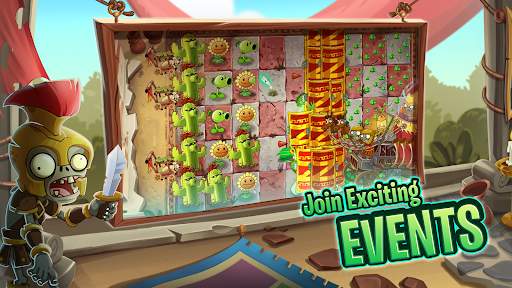
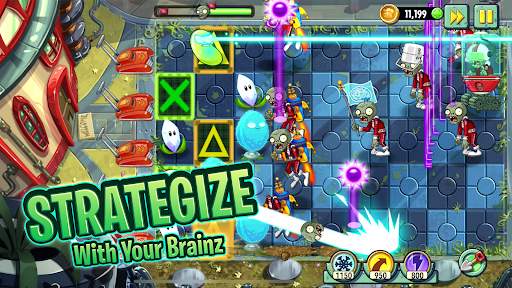
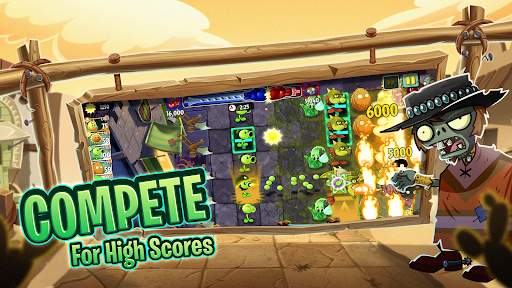
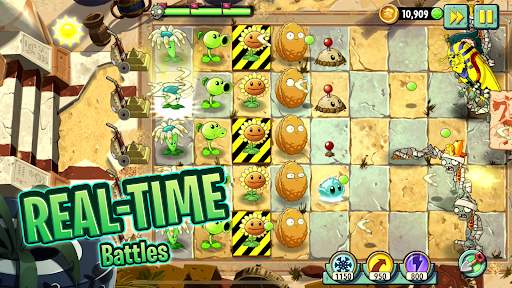
One of the most notable qualities of Plants vs. Zombies 2 is the use of themed worlds. Ancient Egypt, Pirate Seas, and Wild West are not simply different backgrounds. Each of them reshapes the way you judge danger. Ancient Egypt exposes you early to pressure that steals tempo and drains resources. Pirate Seas uses divided space and lane compression to make you understand the importance of coverage efficiency. Wild West, with its rail system, forces you to rethink mobility within firepower placement. The shift from one world to another is not only visual. It is a shift in tactical logic. You cannot use one rigid idea to clear the entire game, and that is exactly where its maturity appears. It keeps reminding you that true strategy is not the memorization of answers. It is the repeated adjustment of yourself after you understand the rules. It also creates a subtle psychological state. You accept failure, but you do not want to fail, so you unconsciously learn from your mistakes and move toward something close to a perfect strategy. This process is different from what happens in many high pressure games. It does not make you doubt whether you should continue after losing a stage, and it does not turn defeat into humiliation. When you lose, your first thought is usually not that you are inadequate. You think instead that perhaps that move was too rushed, that the chosen seed packets were wrong, that Plant Food was spent too early, or that one lane needed control before it needed damage. In other words, the game turns failure into something that can be broken apart, reviewed, and improved. You admit that this particular round went badly, but you do not treat that bad result as a verdict on who you are. Because of that, pressing restart becomes immediate, and the next attempt often feels distinctly cleaner.
What makes the game even more appealing is that it does not require you to treat every mistake with heavy seriousness. You may even laugh at your own errors, and that is one of its most attractive qualities. You may already know that one lane is close to collapse, yet because of one greedy move you waste Plant Food and then watch the zombies break through. At that moment, you may feel annoyed, but a second later you may also laugh. The overall tone, the character animations, and even the way defeat is presented keep the experience from becoming oppressive. It often feels less like punishment and more like the game catching you in a very recognizable mistake. From a systemic perspective, one of the most interesting angles of Plants vs. Zombies 2 is the way it strengthens the sensation that you always play as a winner. Even when the situation looks terrible, your way of thinking is not that of someone begging to survive. You are trying to take back initiative. You calculate whether one control option can buy enough time to restore tempo. You ask whether one use of Plant Food can blow open the critical point of pressure. You judge whether it is worth abandoning one side lane in order to preserve the economy of the whole field. You are not passively waiting for an outcome. You are constantly organizing a counterattack.
That is one reason the game becomes so absorbing. Even though the visible goal is defense, the psychological state of play feels closer to command. You are not someone barely protecting yourself. You are more like a commander who repeatedly corrects deployment and drags the field back under control. Even when you lose, you rarely leave with the mentality of a loser, because you know the next round will be stronger. That feeling is closely connected to the central fantasy of the game. The flowers and the zombies may think that this is their battle, but it is actually you, the human being behind the screen, who controls everything, and that feels wonderful. On the surface, the active figures on the field are the plants and the zombies. One side resists and the other advances, and they collide across the grid. But once you have played deeply enough, you become more and more aware that the real organizer of every exaggerated animation, every intense clash, and every changing situation is you. You decide which plants appear. You decide when firepower becomes complete. You decide which lane receives priority. You decide whether resources should be saved or spent. You decide whether Plant Food is used for rescue or for suppression. You decide whether the entire battle will move toward stability, risk, or an extreme comeback. What you witness is not only the collision of units. It is the gradual realization of your own judgment.
This game resembles a constantly changing examination paper. It adds Plant Food and also more moments that emphasize immediate decision making, so the pleasure no longer comes only from asking whether you built the correct formation. It also comes from asking whether you can make the right choice at the most critical second. This makes it more likely to produce unforgettable moments. You remember one round in which everything nearly collapsed but was rescued through exact timing. You also remember another round in which you thought every calculation was perfect and then lost everything because of one careless detail. It creates more memorable points, and those points are not handed to you by story. They are created by your own play. So Plants vs. Zombies 2 is not merely a sequel. It is a strategy game that keeps pushing you to become smarter without stripping away your sense of ease. It makes you serious, but not heavy. It lets you fail, but does not let failure swallow you. It makes you rebuild formation again and again until the battlefield that once seemed chaotic begins to operate exactly according to your will. At that point, what you gain is no longer only victory over a stage. You gain a clear, exciting, and deeply personal sense of control!