Editor's Review:
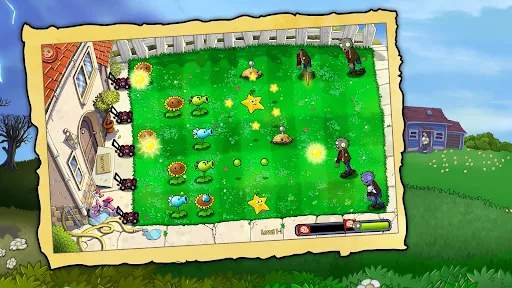
Plants vs. Zombies is a classic strategy game, mainly focusing on tower defense, while also integrating resource management, deck construction, and rhythm control. Its greatest strength does not lie in how complicated its rules are, but in the way it achieves accessibility and depth at the same time. Almost anyone can understand within minutes that Sunflowers should be planted early, that Peashooters need proper placement across lanes, and that Wall-nuts exist to buy time. Yet after playing for a longer time, you will realize that this is not a simple casual game dependent only on reaction speed. It also involves prediction, spatial efficiency, cost management, and psychological control under pressure. What first captures you is the remarkably intelligent handling of art style and theme. The plants are anthropomorphic, adorable, and often slightly silly. The Peashooter looks earnest, the Sunflower seems permanently cheerful, and the Wall-nut feels like a dependable friend who can absorb endless stress. The zombies, by contrast, are ridiculous but also unpleasant, gray-faced, slow, grotesque, and unmistakably threatening. Because of this contrast, the game creates a very special emotional structure. The player is not merely eliminating abstract objects. The player is commanding a group of charming and expressive plants to hold back wave after wave of evil and vaguely disgusting zombies from crossing the lawn. That pleasure feels different from the pleasure offered by many other tower defense games.
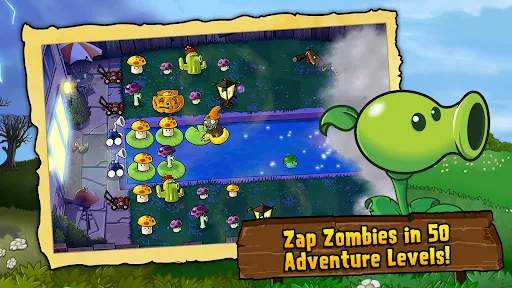
It is not simply a release of aggression. It is a kind of domination shaped by aesthetics and sympathy. You want to protect these lovable plants, and for that reason you enjoy even more the sight of those ugly, greedy, advancing zombies being frozen, blown apart, stalled, and destroyed. This design of cuteness confronting ugliness is not decoration. It directly changes the way the player invests emotionally in the conflict. Many players remember Plants vs. Zombies as simple and easy to pick up, but anyone who has really played it for a long period knows that the core strength of it is rhythm. Day levels teach the player sunlight production and basic firepower deployment. Night levels introduce free mushrooms and different economic logic. Pool levels force a reconsideration of lane count and line coverage. Fog levels turn incomplete information itself into a source of stress. Roof levels alter trajectories and demand another rethinking of formation. The game does not merely increase difficulty level as it moves forward. It continually reshapes your understanding of the same rules. Just when you think a standard answer has been mastered, the next area demonstrates that terrain, sight, lane structure, economic speed, and special enemies can all invalidate old habits. All strong strategy design understands one thing. Better strategy does not simply mean stronger numbers. It means pressure to update a way of thinking.
In many tower defense games, difficulty comes from frantic execution. In Plants vs. Zombies, much of the real elegance comes from the row of seed packets selected before a level even begins. What you bring into a match is essentially a statement of what you fear, what you understand, and what rhythm you intend to create. If there are many Buckethead Zombies, do you prepare higher damage in advance? If there are Miners, Pole Vaulters, or Dolphin Riders, do you leave room for specific answers? It feels as if you are choosing plants, but in truth you are signing your tactical thinking. The brilliance here is that the game never uses an intimidating wall of numbers to push players away. Instead, it slowly introduces the idea of construction through very intuitive unit functions. Not every strong plant needs to be brought. Not every usable option belongs in every lineup. The real question is what solution this particular level demands. Because of that, the game possesses the friendliness of a casual experience and the framework of a genuine strategy work. You cannot escape the pull of eliminating all the enemies. Many games ask the player merely to survive, endure, or reach the end. Plants vs. Zombies creates a more powerful compulsion toward completion. You do not only want to pass a level. You want to erase the entire wave and watch the final zombie fall inside a fully established line of fire, restoring order to the lawn. The attraction comes from a very controlled but extremely effective form of tactical satisfaction. Every lane should hold. Every gap must be sealed. Every wave has to be fully processed. As long as even one zombie remains on the field and continues to move forward, the tension in your mind does not fully disappear. You know perfectly well that this is only a lawn divided into a few lanes with a limited set of units. Yet, the game makes total elimination feel like an irresistible force. This is one reason it becomes so difficult to stop playing. The appeal does not come from vague promises of progression. It comes from a sequence of tactical loops that can be cleanly completed.
Another major accomplishment of this game lies in the handling of failure. In real life, most people hate failure because failure often feels like a denial of competence, a lowering of evaluation, or even damage to self-worth. In Plants vs. Zombies, however, one becomes strangely willing to try again and again until victory arrives. More importantly, this process rarely wounds the ego. The reason is not that the game lacks difficulty. The reason is that failure has been redefined as updated information. When a level is lost, the player usually does not think, "I am not good enough". The player instead thinks, "perhaps sunlight collapsed too early, perhaps the Wall-nut in that lane came down too soon, perhaps the danger of Balloon Zombies was underestimated, perhaps the set of cards was not built correctly". This kind of failure is local, readable, and repairable. It does not point toward the worth of the person. It points toward the decisions of that one attempt. Because of this, restarting becomes rational and relaxed. It does not feel like stubborn refusal after humiliation. It feels like returning with sharper understanding, just as Samuel Beckett once wrote, "Ever tried. Ever failed. No matter. Try again. Fail again. Fail better". After losing, the player does not question whether continuing is worthwhile. The reaction is much more natural. The whole gameplay invites the player to accept defeat because defeat can be converted directly into more precise planning in the next attempt.
At a deeper level, this game is not only about planting units against zombies. It is actually training a very important strategic instinct. "Should resources be spent immediately, or saved for what is about to come? Which deserves greater priority, the threat already in front of the player, or the one that will arrive in the near future? The value of a Sunflower does not exist only in the present moment. It exists in economic freedom several minutes later. The value of a Wall-nut is not damage, but the conversion of time into opportunity for the back line. A Cherry Bomb looks spectacular, but in practice, it is a purchase that flattens the danger curve of the next stretch of time all at once. The game translates ideas that are often abstract in strategy design into forms that ordinary players can immediately feel under pressure. That is one reason why its popularity was never accidental. It looks light, but its structure is solid. The humor of the game does not weaken the strategy. It strengthens memory and recognition. Conehead Zombies, Buckethead Zombies, Dancing Zombies, and Zombonis are all exaggerated and funny in presentation, yet that humor never causes the player to ignore their tactical meaning, quite the opposite, because they are so distinctive, they become easier to read as threats. At last, even many years later, you still want to enter this world, place a Sunflower in the first row with complete seriousness, and wait like an experienced defender of the garden for the first soft impact of a pea striking a zombie. In that instant, you understand that this strategy game remains one of the few in its genre that feels intelligent, human, and deeply memorable!